Videos
MenoCortex Video Library
Short, plain-language answers to the questions women ask most often about menopause and the brain. Each video has a dedicated page with a fuller written explanation and references.
Videos are educational only. They are not medical advice, they cannot account for your own history or medications, and they are not a substitute for care from your clinician.
Medical Disclaimer
The information on this website is educational and does not replace an individual medical evaluation. It does not diagnose any condition. If you believe you are experiencing a medical emergency, call 911.
Filter by category
Filter by focus
67 videos
Menopause + hormones
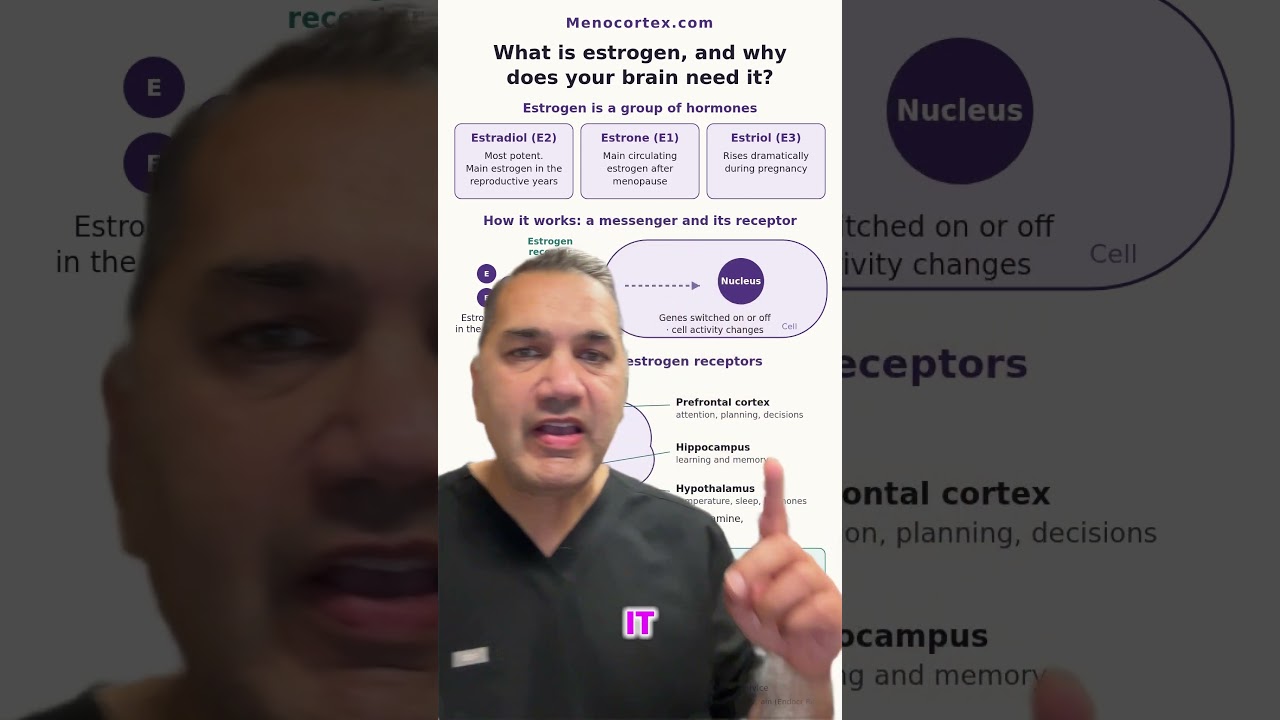
What Does Estrogen Do in Your Brain?
How estrogen affects memory, mood, sleep, temperature regulation and concentration — estrogen receptors across the brain, perimenopause fluctuations, and why hormone therapy is not proven to prevent dementia.

Exercise + nutrition
What Are the Symptoms of Iron Deficiency?
Iron deficiency symptoms in women — fatigue, brain fog, headaches, dizziness, restless legs, hair shedding and ice cravings — why heavy perimenopausal bleeding matters, and how CBC and ferritin help diagnose it.
 2:41
Menopause + hormones
How Do I Know I'm in Perimenopause?
Early signs of perimenopause, including symptoms with regular periods, brain fog, anxiety, sleep changes and hot flashes; how clinicians assess hormone fluctuations and testing.
 5:28
Exercise + nutrition
Creatine and Menopause? What’s the science vs influencer claims?
What clinical trials show about creatine and muscle strength in menopausal women, and why brain fog, memory, mood, estrogen and anti-aging claims need stronger evidence.
 8:13
Migraine + headache
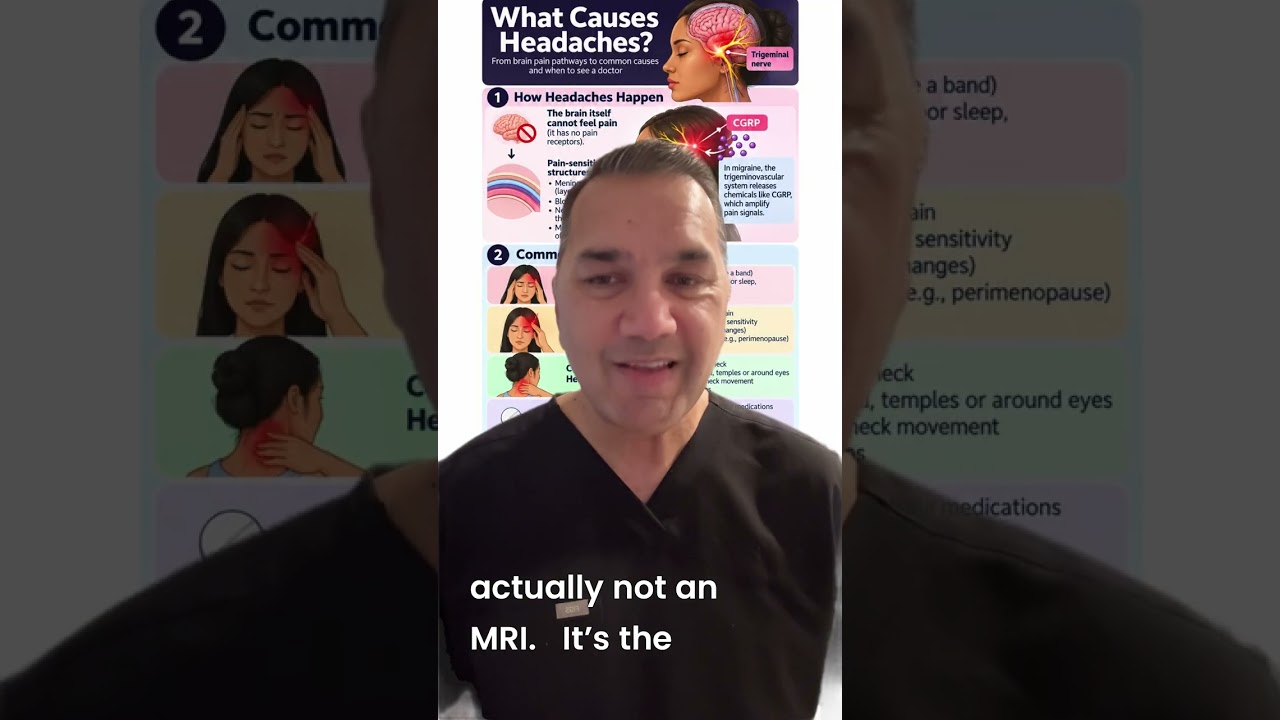
What causes headaches? Be better prepared for your next doctor visit
Headache pain pathways, migraine, tension-type and cluster headaches, warning signs, neurological evaluation, and why headaches can change during perimenopause and menopause.
 7:49
Menopause + hormones
Three Types of Estrogen and How Each Impacts Your Brain During Menopause
How estradiol, estrone and estriol each relate to the brain during menopause—memory, mood, sleep and estrogen receptor signaling—and why physiology differs from treatment evidence.
 6:52
Mood + social connection
How Do Antidepressants Work in Menopause?
How SSRIs, SNRIs and bupropion affect brain signaling, why medication choices differ, and what evidence shows about mood, hot flashes and menopause brain fog.

Menopause + hormones
Menopause Symptoms Explained: 8 Brain Chemicals Behind Them
How estrogen, progesterone, testosterone, oxytocin, cortisol, dopamine, serotonin and norepinephrine interact with brain systems behind brain fog, mood, sleep, motivation and hot flashes.

Dizziness + sensory symptoms
Why Does My Skin Feel Like There Are Bugs Crawling on It?
What formication means, how it differs from paresthesia and neuropathy, why unusual skin sensations may be reported during perimenopause, and when they should be evaluated.

Mood + social connection
What Are the Symptoms of Bipolar Disorder?
The signs of mania, hypomania, bipolar depression and mixed symptoms, and how distinct mood episodes differ from menopause-related mood changes.

Dizziness + sensory symptoms
What Is Sciatica?
Why sciatic nerve or nerve-root irritation can cause sharp, burning or electric pain, tingling, numbness or weakness from the back or buttock down one leg.

Migraine + headache
What Is a Menstrual Migraine?
Why migraine attacks can cluster around a period, how falling estrogen may lower the migraine threshold, and why patterns can change during perimenopause.
Dizziness + sensory symptoms
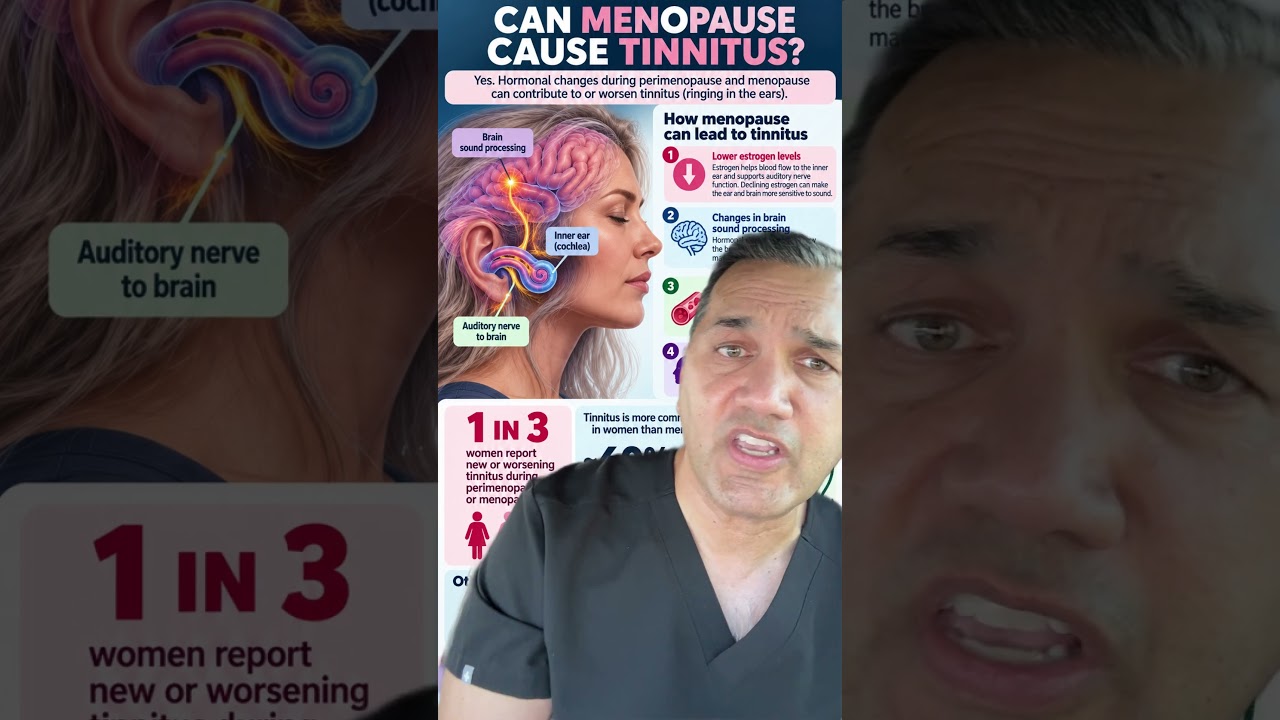
Can Menopause Cause Tinnitus?
Why ringing, buzzing or humming in the ears may change around menopause, how estrogen can influence hearing pathways, and why persistent tinnitus still deserves its own evaluation.

Dizziness + sensory symptoms
Does Menopause Change Your Sense of Smell?
Some women notice smell changes during perimenopause or after menopause. Learn how estrogen-sensitive pathways, aging, infections, sinus disease, medications and neurologic conditions may contribute.

Brain fog + memory
Why Do I Get Brain Fog During Menopause?
Why memory, focus, word-finding and mental speed can feel different during perimenopause and menopause—and why hormones, sleep, mood, stress and other health conditions all belong in the picture.

Exercise + nutrition
The Gut–Brain Connection During Menopause
How the gut and brain communicate through neural, hormonal, immune and metabolic pathways—and what research does and does not show about the microbiome, brain fog and mood during menopause.

Brain fog + memory
Can Menopause Shrink Your Brain?
Why MRI-measured changes in brain volume during the menopause transition are not the same as brain damage — and how remodeling, aging and hormones fit together.

Dizziness + sensory symptoms
What Is Vertigo?
Vertigo is a false sensation of spinning or motion, not simply lightheadedness or imbalance. Learn how BPPV, vestibular migraine and other causes differ — and why vertigo during menopause still deserves its own evaluation.

Menopause + hormones
What Happens to Dopamine in Your Brain During Menopause?
Part 1 of the brain-chemistry series: how dopamine supports motivation, reward and attention, how estrogen interacts with dopamine signaling, and what scientists do and do not know about dopamine during menopause.

Mood + social connection
What Is Cortisol Doing to Your Brain During Menopause?
Cortisol is a normal part of the HPA stress-response system, not a toxin. Why frequent or prolonged stress interacts with memory, attention, emotional regulation and sleep — and how the menopause transition fits in.

Dizziness + sensory symptoms
What Is Neuropathy?
Neuropathy means damage or dysfunction of the peripheral nerves — the nerves outside the brain and spinal cord. What it feels like, what causes it, how it is evaluated, and why tingling in midlife should not be assumed to be menopause.

Vascular + long-term brain health
What Happens to Plaque in Your Arteries After Menopause—and Why Is It Important?
The menopause transition is associated with accelerated atherosclerotic change — and plaque biology is more complex than estrogen keeping plaque soft. Why arteries matter for the brain, not just the heart.

Menopause + hormones
Why Thyroid Problems Can Be Missed During Menopause
Fatigue, weight gain, low mood and brain fog can come from hypothyroidism or from the menopause transition. Symptoms alone cannot separate them — which is why thyroid disease is sometimes overlooked in midlife.

Mood + social connection
What Happens Chemically in Your Brain During Anxiety?
Anxiety is not one simple chemical imbalance. Threat-processing circuits, the CRH-ACTH-cortisol stress response, norepinephrine, GABA, neurosteroids and serotonin all interact — and hormonal change in midlife adds another layer.

Menopause + hormones
If You Start Menopause Early, Start Thinking About Brain Health Earlier
Why early or premature menopause may be a reason to address long-term brain-health risk factors earlier — dementia-risk associations, brain-structure research, cardiovascular risk and the modifiable factors worth acting on now.

Menopause + hormones
Can Progesterone Make You Feel Worse During Menopause?
Why progesterone or a progestogen may make some women feel worse during menopause treatment — mood changes, fatigue, dizziness, headache and brain fog — while others notice better sleep or fewer hot flashes.

Migraine + headache
Can a Migraine Cause a Stroke?
What women should know about migraine with aura and ischemic stroke risk, how perimenopause can change migraine, and why blood pressure, smoking, contraception and menopausal hormone therapy belong in the conversation.

Mood + social connection
What Happens to Your Brain Chemistry During Depression?
Depression involves far more than "low serotonin" — a neurologist explains dopamine and reward, the brain's stress-response system, why depression can cause brain fog, and how mood symptoms fit into perimenopause in women.

Vascular + long-term brain health
High Blood Pressure and Menopause — What You Need to Know
Why blood pressure deserves attention in midlife, what may push it upward around menopause, and why hypertension is one of the most important modifiable risk factors for stroke and vascular brain health.

Brain fog + memory
Brain Fog Despite HRT?
Why brain fog can continue despite hormone replacement therapy — including the roles of sleep, mood, thyroid disease, nutritional deficiencies, medications, migraine, ADHD and other medical conditions.

Brain fog + memory
Can Playing Mahjong Be Good for Your Brain?
Mahjong combines memory, attention, strategy, visual processing, decision-making and social interaction. What a 2024 scoping review of 53 studies found about mahjong and cognition — and why association is not proof of dementia prevention.

Brain fog + memory
Why ADHD Can Feel Worse During Perimenopause
Why attention, organization and emotional regulation can become harder during perimenopause — estrogen, dopamine and executive function, plus why menopause brain fog can resemble ADHD.

Menopause + hormones
How Does Veozah Work and What Does It Do in Your Brain?
How Veozah (fezolinetant) blocks NK3 receptors on KNDy neurons in the hypothalamus to reduce menopause hot flashes and night sweats — without replacing estrogen or acting as hormone therapy.

Dizziness + sensory symptoms
Why Are Your Hands and Feet Tingling During Menopause?
Why tingling, pins-and-needles, burning or numb sensations are reported during perimenopause and menopause — and why neurologic, metabolic and nutritional causes still need to be considered.
Brain fog + memory
Cyclospora Symptoms: Can a Gut Infection Cause Brain Symptoms?
Cyclospora infects the small intestine, not the brain — yet a significant gastrointestinal illness can still produce fatigue, headache, lightheadedness and trouble concentrating. What the recent outbreak teaches about how gut illness affects how you think and feel.

Exercise + nutrition
Low Iron and Treated, but Still Fatigued? Another Vitamin May Be the Reason
New 2026 research in adults with iron-deficiency anemia found that those who were also vitamin D deficient improved more on several blood measures over 90 days when vitamin D was added to iron-containing therapy. Interesting emerging evidence — and what it does not prove about persistent fatigue.

Migraine + headache
Ubrelvy for Migraines: What Does the Data Show?
Ubrelvy (ubrogepant) is a CGRP-receptor antagonist approved for the acute treatment of migraine. What the pivotal trials actually found for two-hour pain freedom, most bothersome symptom and pain relief — plus what the data do and do not show in women and in perimenstrual attacks.

Menopause + hormones
Estradiol Patch Shortage: Would This Happen If It Were a Men's Health Medication?
Why some women are struggling to fill their usual estradiol transdermal patch: rising demand, what the FDA said on September 3, 2026 about working with all six manufacturers, what patients can do — and the harder question the shortage raises about attention to women's health.

Sleep
Why Won't Your Mind Shut Off, Even When You're Exhausted?
The 'tired but wired' experience of perimenopause and menopause — the body feels exhausted while the mind keeps worrying, planning or replaying the day. Why cognitive hyperarousal keeps insomnia going, and what actually helps.
Dizziness + sensory symptoms
Can Menopause Cause Chronic Dizziness?
Dizziness that persists for weeks or months is a different question from brief episodes. How hormonal changes may affect the vestibular system during menopause, why a 2026 review calls the evidence limited, and which treatable causes still deserve consideration.

Exercise + nutrition
Could Pickleball Be Good for Your Brain?
Pickleball combines physical exercise with rapid decision-making, visual tracking, coordination, balance, reaction time and social interaction — an open-skill activity that keeps both brain and body working. What emerging research shows, and what it does not.

Vascular + long-term brain health
If Your Parent Has Alzheimer's Disease, Will You Get It?
A parent's Alzheimer's diagnosis raises your risk but does not decide your future. Why most Alzheimer's disease is not caused by one inherited gene, what APOE4 does and does not tell you, how rare inherited forms differ, and which parts of the risk picture can actually change.
Dizziness + sensory symptoms
Brain Zaps: What Are They?
The brief electrical-shock sensations in the head known as brain zaps — what they feel like, why they are particularly associated with antidepressant dose changes and discontinuation, and why the exact mechanism is still not established.

Exercise + nutrition
Menopause Bloating: Can Fermented Foods Help or Hurt?
Why bloating is common during perimenopause and menopause — motility and transit changes, constipation, dietary triggers, fluid retention and body composition — and why fermented foods help some women while temporarily worsening gas in others.

Menopause + hormones
How Does Testosterone Impact Your Brain During Menopause?
Women produce testosterone, and the brain carries androgen receptors — plus aromatase converts some testosterone into estradiol. What that means biologically, and what testosterone therapy has and has not been shown to do.

Menopause + hormones
Women Aren't Small Men — They Deserve Their Own Brain Health Research
Why women's brain health needs to be studied directly: sex-specific physiology, reproductive transitions such as menopause, and the historical underrepresentation of women in parts of medical research.

Exercise + nutrition
Can Dancing Be Good for Your Brain?
Dancing combines aerobic exercise with memory, coordination, balance, rhythm, attention and social engagement — which is why it is studied as brain-health activity, and why it is still not proof of dementia prevention.

Brain fog + memory
Can Hair Loss Be Related to Brain Fog During Menopause?
Hair thinning does not cause brain fog, but the two are often reported together during the menopause transition — sometimes because they share an underlying cause such as thyroid dysfunction, iron deficiency or disrupted sleep.

Mood + social connection
Why Can Stress Feel Different During Menopause?
How the amygdala, prefrontal cortex, hippocampus and HPA stress-response system work together, how estrogen interacts with those networks, and why stress can feel different during the menopause transition.

Menopause + hormones
What Happens to Your Brain During a Hot Flash?
Why a hot flash starts in the brain's temperature-control system — the hypothalamus, estrogen signalling and KNDy neurons — and why flushing, sweating and heart-rate changes are a coordinated heat-loss response.

Vascular + long-term brain health
Does Your Heart Suddenly Start Racing During Menopause?
Why heart palpitations and a racing heart are common in perimenopause and menopause, how the autonomic nervous system, hot flashes and sleep fit together, and which other causes still deserve evaluation.

Vascular + long-term brain health
Should You Check Lipoprotein(a) and Apolipoprotein B During Menopause?
What lipoprotein(a) and apolipoprotein B measure, why these cholesterol components come up in midlife, and how they fit into cardiovascular and long-term brain health.

Exercise + nutrition
Can Exercise Make Your Brain Work Better After Menopause?
What exercise does and does not do for thinking, memory and long-term brain health after menopause — and why blood pressure, glucose, sleep, mood and muscle are the best-evidenced routes.

Menopause + hormones
What Is Happening to Your Brain During Menopause?
A neurologist's overview of the menopause transition through the systems the brain controls — sleep, temperature, pain, attention, mood and blood pressure regulation.

Menopause + hormones
Can Hormone Therapy During Menopause Prevent Alzheimer's Disease?
Why hormone therapy is not indicated for dementia prevention, why the studies conflict, what the timing hypothesis does and does not show, and where midlife effort is best spent.

Sleep
Why Do You Wake Up at 3am During Menopause?
Why middle-of-the-night waking is so common in the menopause transition — lighter late-night sleep, night sweats, hormones, alcohol, cortisol and sleep apnea — and what helps.

Neurologic conditions
Does Menopause Make Multiple Sclerosis Worse?
What is known about multiple sclerosis around the menopause transition — overlapping symptoms, disability progression, and why an MS symptom change should never be assumed to be menopause.

Mood + social connection
Can Loneliness During Menopause Affect Your Brain?
Why loneliness and social disconnection during midlife matter for mood, sleep, memory and long-term brain health — and what the research does and does not show.

Migraine + headache
Why Are My Migraines Getting Worse During Menopause?
Why migraine patterns often change during perimenopause and menopause — fluctuating estrogen, the trigeminal system and CGRP, and when a changing headache needs evaluation.

Brain fog + memory
Can Menopause Change the Structure of Your Brain?
What brain-imaging research shows about changes in brain structure, connectivity, metabolism and function during the menopause transition — and what it does not show.

Exercise + nutrition
Why Does Menopause Cause Weight Gain? The Brain Plays a Role
How estrogen interacts with brain systems for appetite, satiety, reward, sleep and energy expenditure — and why fat distribution shifts in midlife.
Menopause + hormones
Can Hormone Therapy Improve Mood During Menopause?
How estrogen interacts with brain systems for mood, whether hormone therapy may help some women, and why it is not a treatment for major depression.

Dizziness + sensory symptoms
Can Menopause Make You Feel Dizzy?
Why dizziness and lightheadedness are reported during the menopause transition — and which inner-ear, migraine, medication and neurologic causes still deserve consideration.

Exercise + nutrition
Can Nutrition Improve Brain Health During Menopause?
A short explanation of how dietary patterns — not single 'brain foods' — connect to brain health during perimenopause and menopause.

Dizziness + sensory symptoms
Can Menopause Cause Tingling and Numbness?
Why tingling, numbness and pins-and-needles sensations are reported during the menopause transition — and why the pattern, not the hormones, usually identifies the cause.

Vascular + long-term brain health
Can Menopause Change Your Cholesterol?
How lipids, body composition, insulin sensitivity and blood pressure shift across the menopause transition — and why that matters for long-term brain health.

Vascular + long-term brain health
Can Menopause Affect Blood Pressure and Brain Health?
Why monitoring blood pressure during and after menopause is important for stroke prevention and long-term cognitive health.
Share this page
Send this page to someone who may find it helpful.
The MenoCortex Brief
Get the Free MenoCortex™ NewsletterJoin the MenoCortex Newsletter
Get exclusive menopause and brain-health videos, my weekly neurologist's take on new research, practical insights, and subscriber-only tools.Science-based insights on menopause, brain health, memory, mood, sleep, hormones, and healthy aging.
Free. Unsubscribe anytime. Educational information only. Privacy Policy.